Model of Excellence

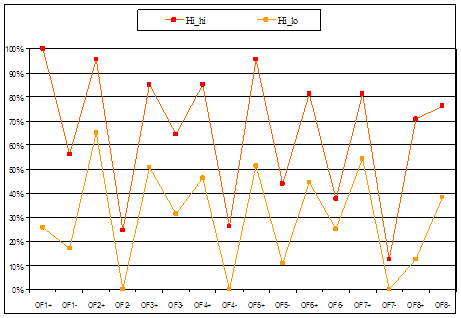
Building the ModelA Model of Excellence answers the following question: “What is the difference between a top performer and a low performer?” This page focuses on several approaches one can follow to come up with a model, independent of the technology being used, and independent whether one considers the attitude, the values or the competencies (or all of them). 1. Standard Group Below, Figure 1 gives an example of such a standard group for the 16 operating factors measured by the iWAM questionnaire:
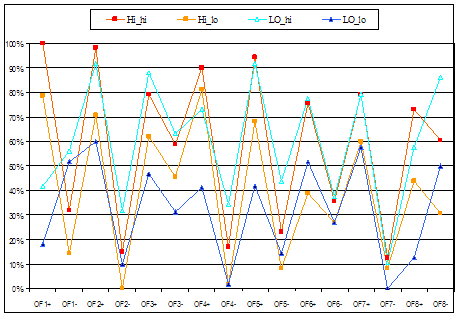
2. Contrastive Analysis The principle of contrastive analysis can be combined with a statistical approach. It is easy to draw a chart indicating the “standard group” for high performers and comparing that area with the standard group of low performers. One can also use the data to see which parameters showed a significant difference between the groups.
Figure 2 shows again the same 8 persons consisting the model of Figure 1. In this figure, the group has been split up according to their performance. Parameters for which the data showed a significant difference between the means will be visually recognizable (e.g. OF1+ indicates “starting”: the top performers value “taking initiative” to a much higher extend than the persons considered “low performers”. OF1- indicates that top performers have less patience, etc.) For significant parameters there will be little or no overlap between the scores for both groups. When one compares Figure 1 to Figure 2, one will also notice that the zone that will be considered “the Model of Excellence” will be much more narrow for figure 2. A contrastive analysis results in a model with a higher degree of precision. For instance, using the model of figure 1, we might consider a person with a score of 25% for OF4- as being “within range”, while figure 2 indicates that the only persons with a score of more than 19% are those belong to the least performing respondents. 3. Engineering the Model First, one can build a model based on general knowledge about the function and the context the person will have to operate in (the management style, company culture, etc). Secondly, one can select some persons who have held the function or who one deems able of holding the function and build a model inspired on their scores. And of course both options can be combined. This approach is more limited than others, because we only have information to situate the top performers, but no information on the significance of the zone we consider the model of excellence. This lack of information can be lessened with general knowledge of what are considered good patterns for the function and of what is the standard group for the given culture (either the country the selected persons are working in or their company culture). 4. Modeling Competencies using COMET However, given the wide array of competences one can distinguish,
a questionnaire such as That’s why jobEQ defined COMET as a methodology for which we also make a 360° test tool available. The COMET/EQ questionnaire on the jobEQ website is actually just an application, showing the use of an assessment tool based on this COMET methodology, and the demo-version only allows to use it in the context of self-assessment. However,the core of the COMET method is building a competence grid and a competence dictionary for a specific job function, based on an analysis of the competencies present in top performers holding that function. By preference this analysis also includes a contrastive element, where we compare these competencies with competencies found in lower performers. A custom questionnaire is then developed based on the competence dictionary. This questionnaires tests to what degree the person tested applies the behaviors described in the competence dictionary as defining elements of the competencies. Ideally this questionnaire is tested statistically on top performers and low performers to see whether it helps to predict job performance, before it is administered to third persons. Conclusion The approach you use will be tailored to your specific organization. The main questions will be “What kind of information can the company offer about its top performers?" “How precise can we distinguish top performers from other groups?” and “How many persons can be tested?” |
- Model of Excellence
- Advantages of a model
- How we build a model
- Recruiting
- Products
- COMET/EQ Research
Other Pages
Results
Browse our case studies to learn how we have helped other organizations with similar needs to yours!
 |
Buy from Amazon: 7 Steps to Emotional Intelligence Patrick E. Merlevede, Denis Bridoux  Mastering Mentoring and Coaching with Emotional Intelligence Patrick E. Merlevede, Denis Bridoux |
| Privacy Information |
